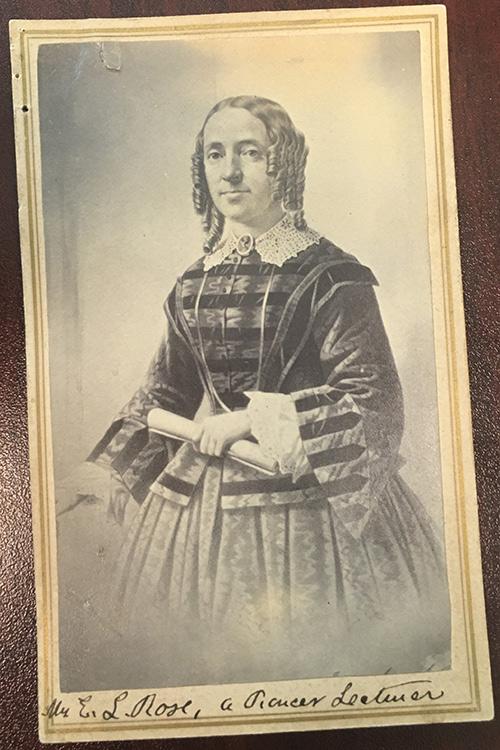
While working through the material objects in the ITPS collections, I came across a time capsule previously buried beneath the cornerstone of the Thomas Paine Memorial Hall in Boston. This building stood on Appleton Street until it burned down on January 9, 1940. This time capsule had been saved by John A. Bremner, the president of the Thomas Paine Memorial Corporation, and was donated to the Thomas Paine National Historical association and opened for the first time in April 1983. The box contained a series of photographs and illustrations of people associated with the Boston Investigator, a newspaper dedicated to free thought and located in the Thomas Paine Memorial Hall in the nineteenth century. Among a collection of photographs and prints of men is the image of one woman, Mrs. E.L. Rose.1
Who was she and how did she end up in the time capsule?
Ernestine L. Rose was born in Poland to a Jewish family. After refusing her arranged marriage, she went to Prussia and resided all over Europe before going to England. While in England she became friends with Robert Owen and became an Owenite. While living with the Owenites, she met her husband William Rose. They then immigrated to New York. While in the United States, she went on speaking tours promoting women’s rights and antislavery. She became friends with Susan B. Anthony and Elizabeth Cady Stanton. She supported and successfully helped the passage of a law in New York that would allow a married woman to keep her own property.2
Her speaking tours brought her to Boston and into the circle of the Boston Investigator, a free-thinking newspaper. She befriended many of the editors and contributors and similarly viewed Thomas Paine as one of her heroes. She likely ended up in the time capsule because of her friendships and her contributions to the newspaper. She famously wrote a response defending Jews and Judaism after Horace Seaver, the editor of the Boston Investigator, wrote an antisemitic article about Jews in the United States.3
Ernestine Rose should be restored to the narrative for her important role in the woman’s movement and other reform movements of the 19th century. While scholars have written about her, especially in the last few years, many have never heard of Ernestine Rose. I surely hadn’t before I came across her image, but now will think of her alongside Susan B. Anthony and Elizabeth Cady Stanton in the fight for women’s rights. As we are in the year celebrating the centennial of the 19th amendment, let’s remember Rose’s role in the suffrage movement and place her back into the historical narrative.
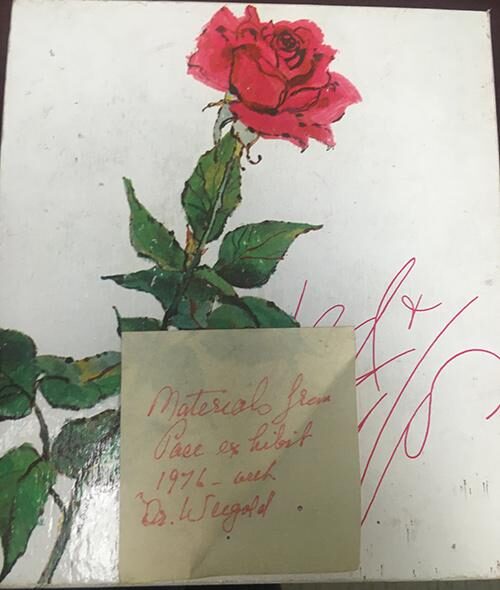
With Thanksgiving safely behind us, the holiday season is now officially in full swing! This is the time of year for sales, gifts, giving, and New York’s famous Fifth Avenue holiday store windows. The Thomas Paine National Historical Association (TPNHA) collection has an artifact related to this holiday shopping tradition, a vintage Lord and Taylor box.
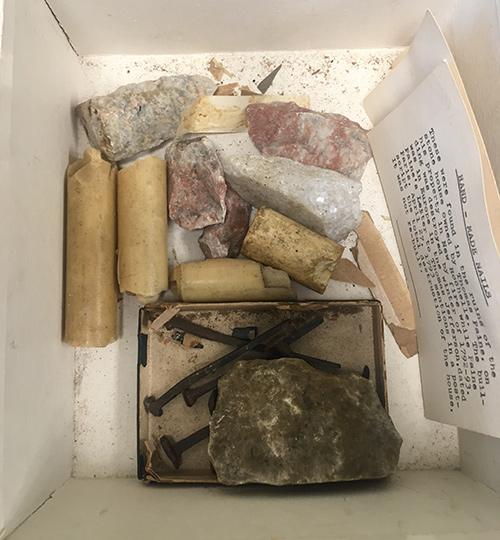
You might be asking yourself, what does a vintage Lord and Taylor box have to do with an archive related to Thomas Paine and the TPNHA? Some artifacts in the collection are stored in one of the Lord and Taylor boxes with the red rose on it. The box contains nails that were once part of Paine’s home in New Rochelle, some used candles, some pieces of paper, and several rocks. While the materials related to Paine and the TPNHA are of historical relevance, the floral box has itself gained historical value. Within the last year, Lord and Taylor’s flagship store on Manhattan’s Fifth Avenue closed, while just a few weeks ago Barney’s New York announced they will be closing their flagship as well. It appears that the fancy and luxurious department stores with their famous names, addresses, and holiday windows are on course to becoming a relic of the glittering past. (Though as an exception Nordstrom just opened their first Manhattan store).
This vintage Lord and Taylor box was likely chosen out of convenience. The TPNHA needed a box to hold materials and this one was available, and since there were so many of them around it didn’t have much value at the time. With changing retail patterns, however, the box has gained value over time—it now has its own interesting history.
The Lord and Taylor rose was first introduced by Dorothy Shaver in 1946. Shaver became Lord and Taylor’s president in 1945, a position she held until her death in 1959—the first woman to hold such a position. The rose on the box is an American Beauty Rose, which became available in the United States for purchase in the 1880s. Shaver introduced this branding as part of her program to promote American fashion, and Lord and Taylor used the rose on all branding until the end of the twentieth century. In 2008, Lord and Taylor reintroduced the rose in its branding, but as a bright orange Sunrise rose. This was then replaced by the Free Spirit rose, a pink, orange, and coral rose in 2016, advertising the nostalgia of the original red rose box.
With department stores like Lord and Taylor closing, their boxes have accrued cultural and nostalgic value even when holding materials related to Thomas Paine. While this box has come a long way from holding a gift, it now serves two purposes: holding materials related to Thomas Paine and his time, and as a symbol of material culture from a not too distant past of shopping on Fifth Avenue or in one of the suburbs that boomed after World War II.
One week before Christmas 1776, patriot writer and war correspondent Thomas Paine packed his latest dispatch in a leather pouch and shoved it into his saddle bag and hit the road, bound towards his Philadelphia publisher from the Continental Army camp near Trenton, New Jersey. After helping to ignite public opinion in favor of American independence in his explosively popular pamphlet Common Sense in January 1776, Paine spent autumn and winter traveling with the Continental army, joining it at Fort Lee, New Jersey shortly after the battle we are commemorating today. Paine observed first-hand the aftermath of the Battles of Brooklyn, White Plains, and Washington Heights—the early nadir of the drive towards independence, when a military victory against the powerful British Empire seemed remote. Paine spent his days consulting with Continental officers, and his evenings circulating among the shivering and demoralized Continental troops, men fresh with memories of the sacrifices made hereby soldiers like the “Maryland 400” at the Old Stone House.
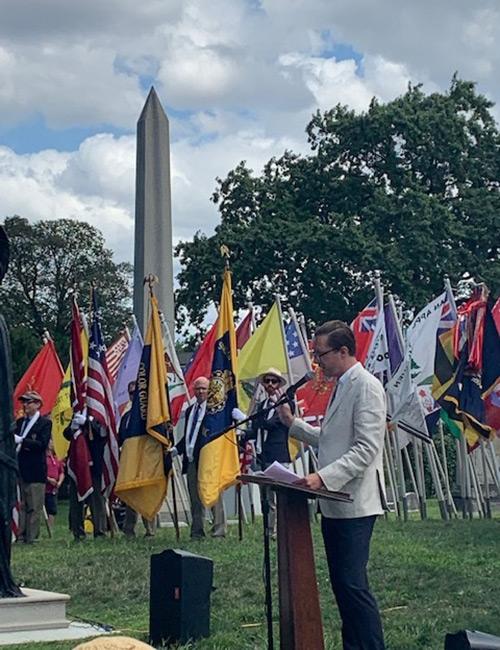
Michael Crowder delivering the keynote address at the Battle of Brooklyn Commemoration at the Green-Wood Cemetery.
The first lines of the late December dispatch were an expression of hope and determination in a time of despair, composed by campfire on a drumhead: “These are the times that try men’s souls. The summer soldier and sunshine patriot will, in this crisis, shrink from the service to his country; but he that stands it now, deserves the love and thanks of man and woman.” Paine intended these words, the first sentences of what would become a thirteen-part series called the American Crisis, to offer reassurance to the flagging spirits of patriot men and women, soldiers and civilians alike, at the close of a year that began with the publication of Common Sense, peaked with the Declaration of Independence in July, a year drawing to a violently uncertain conclusion. But after the famous opening I just quoted—familiar to many of us today, and so much a part the national fabric that often twenty-first Americans know the first line even if they don’t know who wrote it, or its immediate context—Paine supplied readers with a brief history of the political and military events of 1776, spun to reinforce the righteousness of the American cause. In other words, one might say that Paine offered the very first commemoration of the “Spirit of ’76,” written from the tumult of an uncertain moment, confronting an unknowable future.
Commemoration of the American Revolution, and the crucial role of the Battle of Brooklyn in the early stages of the war, is what brings us together today in this beautiful, spiritual, and hallowed space. But what exactly does it mean to commemorate? Its meaning goes beyond celebration of past events and the heroic but fallible men and women that shaped them, even further than recognizing and respecting the past. While commemoration is the act of remembering and celebrating, it is much more than that—the practice of commemorating seminal events like the Battle of Brooklyn and the American War for Independence reveals how we collectively understand the present. History as commemoration is a lens through which we make sense of the often chaotic and contested modern America—but crucially, the practice of commemoration, in forms like today’s solemn but uplifting event, also reminds us that how we shape our past is simultaneously how we shape our future. And nowhere is this truer than how the American Revolution commemorations, in the past, present, and in the future.
Beginning with Thomas Paine,the most famous civilian apostle of the American Revolution, the act of declaring, fighting for, and securing independence meant different things to different people. Paine admitted as much in 1782—before the war formally concluded—in a work he initially intended to be the first full history of the American Revolution. But, “it is yet too soon to write the history of the Revolution,” Paine conceded, “and whoever attempts it… will unavoidably mistake characters and circumstances and involve himself in error and difficulty. Things, like men, are seldom understood rightly at first sight.” But that didn’t stop subsequent generations of Americans from trying to craft their own story of the Revolution. In the late 18th and early 19th centuries, the first political parties in American history opposed each other precisely because they interpreted the nation the war created in different terms. The dynamics of partisanship in this period grappled with many of the same questions we continue to debate today—about the role of government in everyday life, about economic policy, about foreign relations, about citizenship and national belonging. The only difference? Alexander Hamilton and Thomas Jefferson didn’t battle it out on Twitter!
In the antebellum period, the decades before the Civil War, commemorating the American Revolution pivoted on the most important conflict in American history—slavery vs. freedom. Though they often disagreed, Abraham Lincoln and Frederick Douglass both interpreted the American Revolution the same way: if the Declaration of Independence stated that all men are created equal, that should apply to all men—regardless of their racial or ethnic background. Lincoln’s way of commemorating the founding generation was to emphasize what he believed was their core belief, that “truth, justice… and mercy might not be extinguished from the land.” Frederick Douglass, an escaped slave who became a powerful and influential orator and journalist, thundered that the “Fourth of July is yours, not mine; you may rejoice, and I must mourn,” until the abolition of slavery was accomplished. Douglass lived to see that day, though it came at the terrible cost of one million lives during the Civil War. Just as importantly, American women had their own thoughts on how to commemorate the Revolution. In 1848, at a convention at Seneca Falls, New York (with Douglass in attendance, I might add), women’s rights activists adapted the exact language of the Declaration to make a powerful argument: “We hold these truths to be self-evident: that all men and women are created equal; that they are endowed by their Creator with certain inalienable rights; that among these are life, liberty, and the pursuit of happiness.” Men and women like Lincoln, Douglass, and the Seneca Falls activists understood freedom and liberty as the central principles of the American Revolution—ideas fundamental to American national identity, even if there has never been a consensus about their precise application. Freedom and liberty—the inalienable rights on the minds of the Patriot soldiers who fought here two-hundred and forty-three years ago—have always been contested principles.
As the 19th century progressed and the 20th century loomed, the United States developed into the Western Hemisphere’s most powerful nation-state and Revolution commemorations sharpened in their focus on patriotism and America’s growing technological might. This was true of the 1876 centennial celebrations, in which more than ten million visitors attended the Centennial Exposition in Philadelphia and gazed in wonder at the modern technological marvels of the day: telephones and sewing machines. In the first half of the twentieth century, the nation underwent convulsive change—from the Progressive Era, when social reformers sought to refashion American identity in response to rapid industrialization and skyrocketing rates of immigration, through World War I, into the prosperity of the 1920s and then the depression of the 1930s, and finally the American-led Allied triumph in World War II. Commemorations of the American Revolution shifted in tandem, from emphasizing patriotism and technological advancement, to viewing the Revolution as the first stage in the development of human history’s most-powerful military and economic nation-state (a prediction, I might add, suggested by Paine in Common Sense all the way back in 1776). By the Civil Rights era, and following through the turn of the century, however, commemorations of the American Revolution began to suggest that the Revolution was not as glorious as suggested by previous generations. In the half-century since the apogee of the Civil Rights Era, both within the ranks of professional historians and in the popular imagination, it is fair to say that the American Revolution has become understood in more complicated terms. The ultimately successful War for Independence led to the founding of a powerful nation rooted in the uplifting principles of freedom and liberty—but did not create a truly egalitarian society, a utopia devoid of internal conflict. But more complex, complicated understandings of the American Revolution are a good thing! Rather than thinking about the American Revolution as a war fought by fake heroes like Mel Gibson in his truly ahistorical 2000 film The Patriot, we now conceive of the founding generation in the rhymes and cadences of Hamilton.
We can’t know how future generations will commemorate the American Revolution, but we do have it in our power to make the interpretation anew again, to adapt a line from Thomas Paine. Revolutions in commemoration, as I suggested earlier, say far more about people living in the present than the historical actors of the past. I offer this idea on a positive note—how we remember the American founding moment, how it is celebrated, and indeed who is remembered, why, and for what, is within our power.